



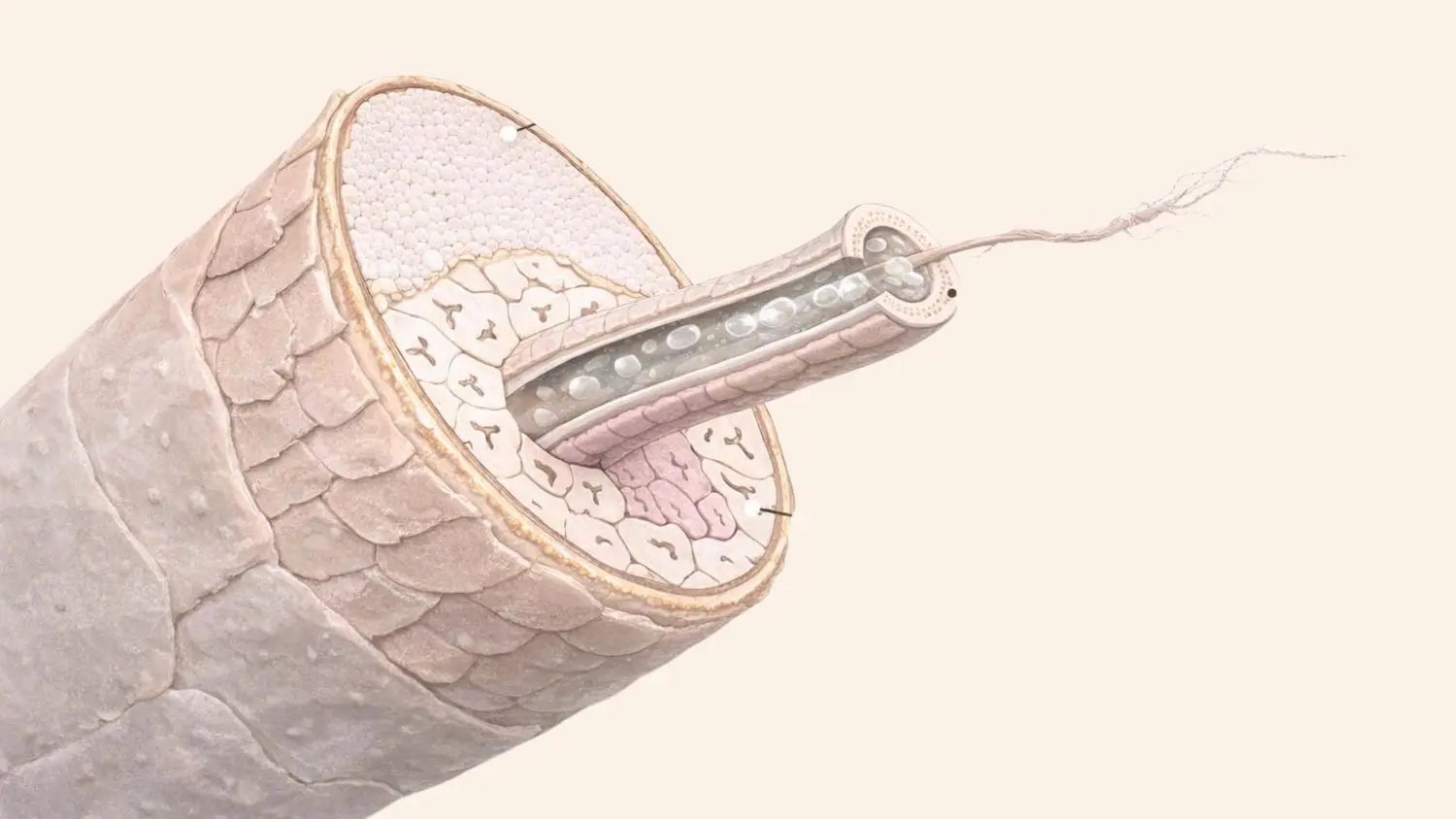
The structure of a wool fiber: why does wool naturally regulate temperature?
When we talk about wool, we often talk about warmth, softness, or comfort.
But what is less known is the very structure of the wool fiber.
And yet... it explains everything.
Wool is not a simple textile fiber. It is a living fiber of animal origin, composed of several layers that work together.
In this article, I simply explain the structure of a wool fiber, using the diagram above (simplified diagram: microscopic reality is even more complex).
You will understand why wool:
- regulates temperature
- absorbs perspiration
- protects from rain
- keeps you warm in winter
- remains comfortable in summer

A wool fiber: 3 main layers
To simplify, a wool fiber consists of three main parts:
- The cuticle (the outer layer)
- The cortex (the main central part)
- The medulla (the central canal, mainly present in thicker wools)
Each has a specific role. But it is their interaction that makes wool so unique.
1. The cuticle: the protective scales
The cuticle is the outer layer of the fiber. It is made of small scales that overlap, much like tiles on a roof.
These scales are naturally covered with lanolin (natural grease produced by sheep).
This layer is hydrophobic, which means it repels liquid water.
When it rains
If a light rain falls on an untreated wool garment:
- The drops roll on the surface
- Liquid water is partially repelled
- The fiber does not immediately soak up water
Wool is not waterproof like plastic, but it offers natural water resistance thanks to this scale structure and lanolin.
This is the first protective barrier.
2. The cortex: the intelligent heart of the fiber
The cortex represents about 85 to 90% of the fiber. It is composed of keratin (like our hair and nails, yes indeed :-)).
And this is where the magic happens.
The cortex is hygroscopic: it can absorb moisture in the form of vapor up to about 30% of its weight, without feeling wet. But it does not work like a sponge: it absorbs water vapor inside the fiber.
When baby sweats
When baby sweats:
- Water vapor passes through the cuticle (it passes between the scales)
- It is absorbed into the cortex
- A microscopic reaction occurs
- This absorption slightly releases heat (exothermic reaction)
Result:
- Humidity is regulated
- The sensation of dampness is reduced
- Odors develop less
- Body temperature is stabilized
Wool does not block perspiration: it intelligently regulates it!
3. The medulla: the air-filled central canal
The medulla is an air-filled central canal, mainly present in thicker fibers. And guess what? Air is an excellent thermal insulator!
This canal allows:
- to trap warm air
- to create a natural thermal barrier
- to improve insulation without weighing down the fiber
When it's cold
When the temperature drops:
- The air trapped in the fiber limits heat exchange
- The cortex regulates humidity
- The fiber remains breathable
This is why wool keeps you warm without causing a suffocating effect.
When it's hot: wool also works
Wool is often associated with winter. And yet, merino wool, for example, is widely used in summer.
But why?
- The fiber breathes
- The cortex absorbs moisture
- Evaporation helps to cool
- Trapped air limits sudden thermal variations
Wool acts as a natural thermal regulator. It doesn't heat the body but helps it stay stable.
It's not one layer that does the magic. It's the whole thing.
The cuticle protects.
The cortex regulates.
The medulla insulates.
But it's the three together that explain the exceptional properties of wool:
- thermoregulation
- moisture management
- odor limitation
- comfort in all seasons
It's a living, complex, intelligent fiber.
What happens when wool is superwash treated?
Superwash treatment generally involves:
- removing or smoothing the scales of the cuticle
- applying a polymer resin to prevent felting
The consequences?
- The natural surface is modified
- Lanolin is often removed
- The protective scales are altered
The fiber can still absorb moisture thanks to the cortex. But the natural balance between the layers is disrupted :/
Superwash wool is easier to care for. But it no longer possesses all the natural properties of untreated wool:
- less natural water resistance
- less self-regulating capacity
- surface closer to a synthetic fiber
Why this changes everything for baby clothes
Understanding the structure of the wool fiber allows for informed choices.
For a baby:
- Thermoregulation is essential
- Sweat management is important
- The skin is delicate
Untreated wool, rich in lanolin, respects the natural balance of the fiber.
I believe you now know the magic of the 3 layers. It is thanks to the 3 layers that the magic operates. It is easy to understand that treatments have a negative impact on the fiber and on the properties we love so much.