






My baby cries at night for no reason: what should I do?
Your baby wakes up crying in the middle of the night. They are clean, fed, safe… and yet they seem inconsolable.
These nighttime awakenings are unsettling for many parents. We search for a cause. We doubt. We worry.
What if these cries actually have several possible explanations?
In this article, I help you understand why your baby cries at night and how to comfort them gently, consistently… and sometimes by simply adjusting their environment.

Why does my baby cry at night?
Crying is your child's first language. At night, it can mean:
- A physiological need (hunger, discomfort, teething)
- A transition between two sleep cycles
- A developmental stage
- A need for emotional reassurance
- Thermal discomfort (too hot, too cold, humidity)
Between 4 and 18 months, sleep changes a lot. The brain matures, motor skills explode, and separation anxiety appears. Night wakings are therefore part of normal development.
But that doesn't mean we can't improve anything.
Common Causes of Night Crying
1. Transitions between sleep cycles
A baby goes through cycles of about 45 to 60 minutes. Between two cycles, they may wake up briefly. If they can't fall back asleep on their own, they will cry out. What I recommend is to wait a few minutes to see if they can fall back asleep on their own.
2. Key development stages
- Acquisition of crawling or walking
- Language explosion
- Separation anxiety around 8-9 months
- Self-assertion
The brain is still developing. Nighttime sometimes becomes a space for emotional integration.
3. An overload of emotions
A very stimulating day, a change of pace, tension felt in the family environment... Babies absorb everything. Just imagine all they experience during the day. The brain needs to sort things out, hence the need to cry.
4. The Sleep Environment
We often think about the routine. We less often think about the materials that baby wears. Yet, they play an essential role in the quality of sleep!
The impact of materials on baby's sleep
A baby does not yet perfectly regulate their body temperature. However, temperature directly influences the quality of sleep.
The limitations of synthetic materials
Polyester and some synthetic fibers:
- Do not breathe properly (or at all)
- Retain heat
- Promote sweating
- Create an overheating effect
A baby who is too hot may wake up more often, be restless, cry for no apparent reason, or have a clammy neck.
Overheating is a common but underestimated cause of night wakings. Many sleep sacks and pajamas contain polyester, even partially.
Why wool promotes more stable sleep
Wool has natural thermoregulating properties. It can absorb up to 30% of its weight in moisture without feeling wet.
Specifically:
- Baby doesn't feel damp if they sweat
- Body temperature remains more stable
- Excess heat is wicked away
- The microclimate around the body is regulated
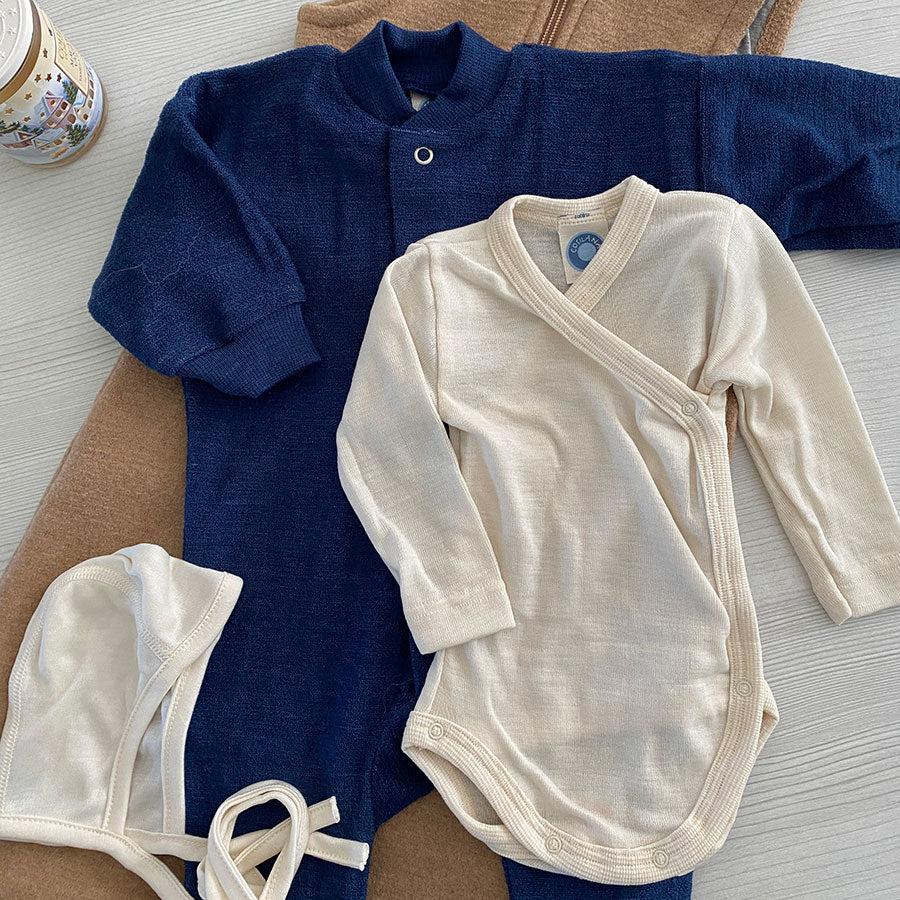
A wool sleep sack combined with a first layer of wool and silk or wool and cotton helps to limit temperature variations and improve nocturnal comfort.
Wool is not "warmer". It is more regulating. This is a crucial difference.
Signs that your baby is too hot at night
- Damp neck
- Wet hair
- Redness on the torso
- Unusual agitation
- Frequent awakenings in the second half of the night
In this case, it may be useful to review the composition of the pajamas, the material of the sleeping bag, and the number of layers of clothing worn.
Sometimes, a simple change of material can transform nights :-)
What to do when your baby cries at night?
1. Check for physical causes
- Clean diaper
- Room temperature (ideally 18-20°C)
- Breathable materials
- Teething
- Signs of illness
2. Maintain a predictable and calm demeanor
Your demeanor is a guide. A soft voice, dim light, slow movements. A baby's brain needs consistency to fall back asleep. The more secure a baby feels, the more they will be able to surrender to sleep.
3. Avoid overstimulation
- Bright light
- Games
- Lively conversation
- Systematic getting out of bed
Night remains night.
4. Maintain a stable routine
Rituals secure the nervous system. Bath, story, song, repeated phrase… Consistency reassures.
When to consult a professional?
It is recommended to consult a healthcare professional if:
- Crying lasts for several hours every night
- Crying is accompanied by fever
- The baby refuses to eat
- Crying persists even when held
- You feel exhausted or overwhelmed
Asking for help is a sign of strength.

In summary
If your baby cries at night for no apparent reason, consider:
- Development
- Cycle transitions
- Emotions
- Temperature and textiles
The question is not just "What to do?" but also "What is he sleeping in?"
A physiologically adapted environment can transform restless nights into calmer ones.
And sometimes, the solution is simply in the fiber :-)