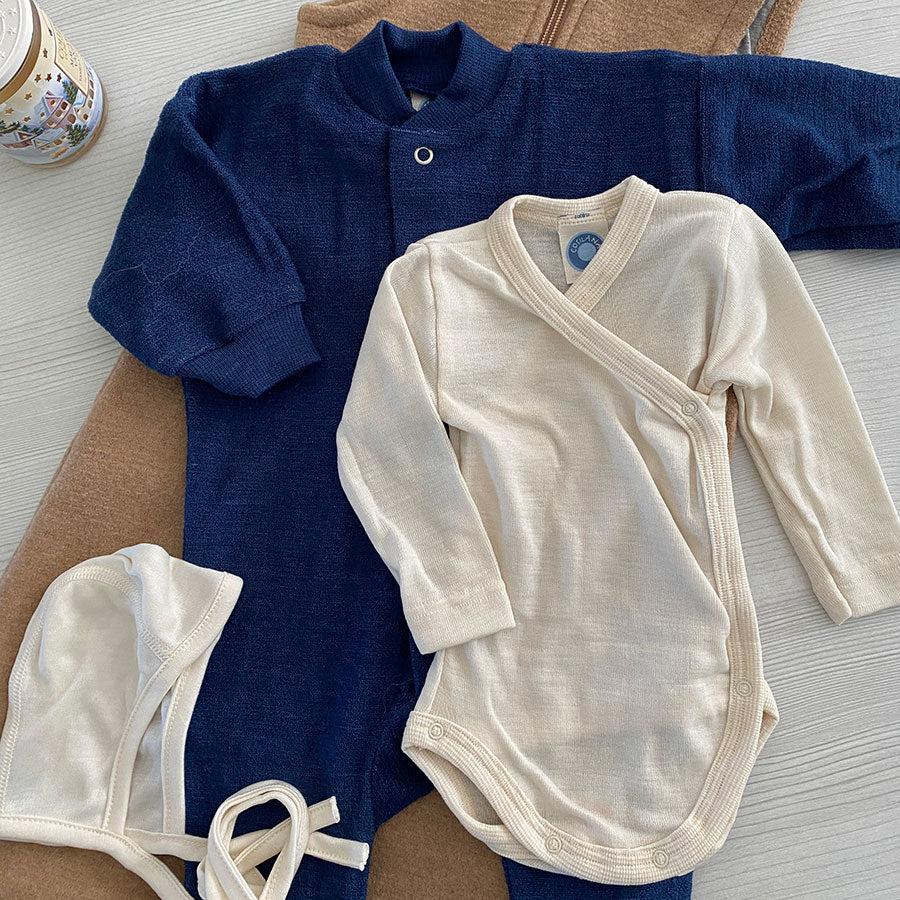
When choosing wool products for your baby, deciphering labels can quickly become a headache. RWS, GOTS, ZQ, OEKO-TEX... What do all these certifications really mean? And most importantly, which one guarantees that the wool has not undergone harmful chemical treatments?
This guide helps you understand what each certification truly protects: animal welfare, worker health, or the absence of toxic substances. You will finally know how to make the best choice for your child's delicate skin.
Why wool certifications are important
Natural wool has extraordinary properties: it regulates temperature, absorbs moisture, and is naturally resistant to bacteria. But between sheep farming and the finished product, many transformations can alter these natural qualities.
The problem with
"superwash" treatment: To make wool machine-washable, the industry often uses a process called chlorine-Hercosett. The wool is immersed in a chlorinated solution that erodes the natural scales, then covered with a polymer resin. The result? Wool that no longer felts... but is no longer truly natural and releases microplastics with each wash.
Certifications help identify wools that meet specific standards.
But be careful: not all are equal, and none cover all aspects of production.
Certifications focused on animal welfare

What it guarantees:
- Animal welfare based on the Five Freedoms (nutrition, environment, health, natural behavior, absence of fear)
- Formal prohibition of mulesing (skin removal practiced in Australia)
- Responsible land and pasture management
- Decent working conditions
- Full traceability from farm to finished product
What it does NOT guarantee:
- No control over chemical treatments applied after shearing
- RWS wool may be superwash-treated or with other chemical processes
- No organic farming requirement
Ideal for: Brands that want to guarantee animal welfare and transparency, but not necessarily "natural" or untreated wool.
Our opinion: This is the most widely recognized international certification. It ensures ethical farming, but if you are looking for wool without chemical treatment, RWS alone is not enough.

What it guarantees:
- Strict animal welfare (mulesing prohibited)
- Sustainable land management
- Traceability down to individual farms
- Economic support for New Zealand farmers
- Environmental and social standards
What it does NOT guarantee:
- Post-shearing chemical treatments are not covered by ZQ alone
- To have a guarantee on processing methods, ZQ must be combined with OEKO-TEX or GOTS
Special feature: ZQ now offers ZQRX, an evolution towards regenerative agriculture with a "regenerative index" measuring carbon, biodiversity, and equity.
Our opinion: Excellent traceability and great farm stories, but check other labels to ensure the absence of chemical treatments.
Important note: Recent investigations have raised questions about the effective adherence to standards in certain ZQ farms, reminding us that no certification is perfect and vigilance remains important.
What it guarantees:
- Everything ZQ covers
- Regenerative approach: active soil improvement, carbon sequestration, biodiversity
Our opinion: For a "new generation of sustainability" discourse, still rare in Europe.
Certifications for organic and untreated wool

THE reference certification for truly natural wool.
What it guarantees:
- Organic farming: sheep fed without pesticides, untreated pastures, prohibition of growth hormones
- Formal prohibition of the chlorine-Hercosett superwash treatment
- Prohibition of wool chlorination
- Oxygen-based bleaching agents are allowed (peroxide, ozone)
- Strict control over all processing methods (washing, dyeing, finishing)
- Dyes free of heavy metals, carcinogenic or allergenic colorants
- Social standards: decent wages, safe working conditions, prohibition of child labor
- Certification of the ENTIRE chain, from lamb's birth to finished product
Machine-washable treatments accepted by GOTS:
- Petry-Lanazym enzymatic process (partial degradation of scales, washable at 40°C)
- Naturetexx plasma treatment (waterless technology using electricity and air)
- EXP process (best available technology, even allows machine drying)
What it does not cover:
- Recycled content (see GRS for this)
Brands using GOTS: Disana, Engel, Cosilana, Tordyvel
Our opinion: If you are looking for truly natural wool, without aggressive chemicals, and ethical from start to finish, GOTS is your best ally. It is the most comprehensive and demanding certification.
But treatment is still possible.
5. IVN BEST (International Association of Natural Textile Industry)

The strictest certification of all.
What it guarantees:
- Everything GOTS covers, and even stricter
- 100% certified organic fibers (GOTS allows a minimum of 70%)
- Total prohibition of all aggressive chemical treatments
- No superwash, no chlorine
- Maximum ecological purity standards
Our opinion: For ultra-committed brands (Disana, Engel). This is the absolute "high-end" label, consistent with a "living, unaltered textile" discourse. If you see it, you have the very best.

What it guarantees:
- Complete organic farming
- Animal welfare
- Ecological pasture management
- No superwash, no chlorine
- From the German organic farming world
Our opinion: Very close to GOTS, often combined with IVN BEST. Excellent guarantee of naturalness.
Chemical safety certifications

What it guarantees:
- Absence of harmful substances in the finished textile
- Tests on over 1000 regulated and problematic substances
- Absence of heavy metals, formaldehyde, pesticides, allergenic or carcinogenic dyes
What it does NOT cover:
- Origin of the wool
- Animal welfare
- Working conditions
- The textile may have been chemically treated; OEKO-TEX only verifies that no harmful residues remain
Our opinion: Excellent certification IN ADDITION to another (RWS + OEKO-TEX, for example). It reassures about safety for baby's skin, but says nothing about production ethics or the naturalness of the process.
What it guarantees:
- Everything Standard 100 covers
- Production in environmentally friendly facilities
- Safe and socially responsible working conditions
- Product traceability
Our opinion: Improved version of OEKO-TEX which adds the social and environmental aspects of production.
What it guarantees:
- Strict chemical safety at every stage of production
- Worker health and safety
- Reduction of environmental footprint (water, energy, waste)
- Compatible with plasma treatment (chlorine-free)
Brands: Very present in technical and outdoor textiles (Icebreaker, Smartwool)
Our opinion: Often combined with RWS. Guarantees clean and responsible production, but not necessarily untreated wool.
Quality and traceability certifications
10. Woolmark
The most globally recognized certification for the quality of virgin wool.
What it guarantees:
- 100% virgin wool (pure new wool) from the shearing of healthy, living animals
- Rigorous tests on 5 quality criteria by independent laboratories:
- Fiber content (verification of actual composition)
- Durability (resistance to stretching, tensile strength)
- Color fastness to light (exposure up to 10h)
- Washing behavior (no shrinkage, shape retention)
- Overall textile performance
- Traceability: each certified product has a unique lot number traceable to the manufacturer
- Guarantee that the wool is neither recycled nor recovered from slaughtered animals
What it does NOT guarantee:
- Animal welfare (Woolmark tests quality, not farming conditions)
- Organic farming or absence of pesticides
- Type of chemical treatment applied (wool may be superwash)
- Working conditions on farms
Focus: Created in 1964, the Woolmark logo is the most recognized textile symbol in the world. Over 5 billion products have been Woolmark certified since its creation. It is a guarantee of quality and durability of the finished product.
My opinion: Excellent guarantee of quality and authenticity of virgin wool. Woolmark ensures that you are truly buying "real" wool and not a deceptive blend. BUT this certification says nothing about production ethics or chemical treatments. For babies, prefer Woolmark IN COMBINATION with GOTS or RWS.
Other certifications
What it guarantees:
- Overall environmental impact (energy, water, waste, dyeing)
- "Clean" European production
What it does not cover:
- Animal welfare
- Organic farming
Our opinion: Interesting for European manufacturers, but less demanding than GOTS.
How to read a label and make the right choice
For 100% natural wool, without aggressive chemical treatment:
Look for GOTS, IVN BEST or Naturland. These certifications formally prohibit chlorinated superwash and aggressive chemical treatments.
Points of vigilance:
- If the label mentions "machine-washable" with GOTS, it means the wool has probably been treated with an ecological process (plasma, EXP, or enzymatic)
- GOTS wool can be machine-washable without being too denatured
To guarantee animal ethics:
Look for RWS or ZQ. These labels ensure that sheep have been well treated and that mulesing is prohibited.
But be careful: These certifications alone say nothing about the chemical treatments applied afterwards.
For baby's safety (absence of toxic residues):
Look for OEKO-TEX Standard 100. This certification guarantees that no harmful substances remain in the finished textile, even if it has been treated.
Ideal: GOTS + OEKO-TEX, or RWS + OEKO-TEX
The best certification combinations:
- GOTS (alone) = organic, ethical wool, without aggressive chemical treatment ✅
- GOTS + IVN BEST = the absolute top for naturalness and ethics ✅✅✅
- RWS + OEKO-TEX = animal ethics + chemical safety ✅
- RWS + Bluesign = animal ethics + clean production ✅
- ZQ + GOTS = traceability + organic + untreated ✅✅
Combinations to question:
- RWS alone = animal ethics OK, but can be superwash ⚠️
- OEKO-TEX alone = no toxic residues, but nothing is known about the rest ⚠️
- No certification = impossible to know what you are buying ❌
Recognize the type of treatment
Signs:
- Mention "superwash", "machine-washable", "easy-care"
- No GOTS, IVN or Naturland certification
- Sometimes OEKO-TEX certification (which only guarantees the absence of residues, not the absence of treatment)
- Very soft, almost silky, slightly slippery feel
Impact:
- Polymer resin = microplastics
- AOX in wastewater
- Loss of the natural character of wool
Ecologically treated wool:
Signs:
- GOTS certification with "machine-washable" mention
- Mention "plasma treatment", "enzyme treatment", "EXP process"
- Sometimes Bluesign
Impact:
- Less aggressive treatment
- No microplastics
- Wool retains more of its natural character
Untreated wool (the most natural):
Signs:
- GOTS, IVN BEST, Naturland
- Mention "untreated", "non-superwash", "hand-wash only"
- Truly "woolly" feel, slightly rough at first
Advantages:
- Intact natural properties
- No chemicals
- 100% biodegradable
- Better thermal regulation
Disadvantage:
- Hand washing recommended
- May felt if poorly maintained
Our recommendation for baby
For baby clothes and wool shorts or pants, prioritize in order:
- GOTS or IVN BEST: maximum guarantee of naturalness, safety and ethics
- RWS + OEKO-TEX: good compromise if GOTS is not available
- Untreated GOTS wool: for parents willing to hand wash
Avoid:
- Wools without certification (impossible to know what they contain)
- Superwash without further clarification (very likely chlorine-Hercosett)
In conclusion
Reading a wool label requires a little learning, but it's the best way to protect your baby and support responsible practices. Remember that:
- GOTS is your best ally for natural and ethical wool
- RWS guarantees animal welfare but not the absence of chemical treatments
- OEKO-TEX reassures about the safety of the finished product but says nothing about the process
- Combinations of certifications often offer the best guarantees
- But beware: there is no certification that states that animal (and human) welfare is respected AND that the wool is WITHOUT treatment.
Do not hesitate to contact brands to ask them what certifications they use and whether their products are superwash-treated or not. Transparent brands will be happy to answer!
At Lilinappy, we prioritize GOTS certified wools and untreated wools to offer your baby the best of nature, without compromise.